Why Your Dog Suddenly Hates Being Alone (And the 5 Things That Actually Work)
Dog separation anxiety can start overnight. Learn the real signs, the mistakes that make it worse, and the 5 proven solutions that actually calm dogs when left alone.
As an Amazon Associate I earn from qualifying purchases.
It starts suddenly. One week your dog is fine when you leave. The next, you come home to a destroyed sofa cushion, a neighbour's complaint about barking, and a dog who greets you as if you'd been gone for three weeks rather than three hours.
You didn't do anything differently. You didn't change your schedule. You just left — like you always do — and something shifted.
This happened with my Labrador at age 4. He'd been fine alone since puppyhood: no barking, no destruction, no drama. Then over about three weeks he started panting when I picked up my keys, scratching at the front door after I left (I put a camera up to check), and refusing to eat the food I left while I was out. The vet confirmed mild to moderate separation anxiety. It took four months to fully resolve. This is what I learned.
What Separation Anxiety Actually Is (And What It Isn't)
Separation anxiety is a genuine panic response — not misbehaviour, not spite, not "dominance." When a dog with separation anxiety is left alone, they experience a stress reaction comparable to a human panic attack: elevated cortisol, rapid heart rate, inability to settle, and increasingly desperate attempts to escape the situation or locate their owner.
This distinction matters because the wrong diagnosis leads to the wrong treatment. Punishing a dog for destruction when you return home doesn't address the anxiety — it adds a second stressor (your anger when you return) to an already distressed dog.
True separation anxiety vs. other common causes:
| Behaviour | Separation Anxiety | Boredom | Insufficient Training |
|---|---|---|---|
| Starts immediately after owner leaves | Yes | No | No |
| Dog is distressed, not playful | Yes | No | Sometimes |
| Symptoms disappear when owner returns | Yes | Yes | Yes |
| Dog won't eat treats left behind | Yes | No | No |
| Physical symptoms (panting, drooling, pacing) | Yes | No | No |
The 5 Clearest Signs Your Dog Has Separation Anxiety
1. They follow you from room to room at home Dogs with developing separation anxiety often show the first signs before you leave. If your dog has started shadowing you constantly — from bedroom to bathroom to kitchen — this "velcro dog" behaviour is a pre-anxiety signal worth taking seriously.
2. They become distressed the moment they see departure cues Picking up your keys. Putting on shoes. Picking up your bag. Dogs with separation anxiety learn these cues weeks before you notice the problem, and their stress begins at that point — not when the door closes. Panting, pacing, or yawning excessively when they see departure cues is the earliest reliable sign.
3. Destruction happens in the first 30 minutes Bored dogs damage things over hours. Anxious dogs damage things in the first 20–30 minutes after you leave, because that's when the panic peaks. A camera (more on this below) will tell you exactly when the behaviour happens — and that timing is diagnostic.
4. They won't eat food you leave behind I tested this deliberately: I left my Lab's favourite treat — a Kong filled with frozen peanut butter, which he would normally go through in minutes — and checked the camera. He didn't touch it for two hours. A dog in a genuine panic state cannot eat. If the food goes untouched for hours and is eaten only when the dog calms down, you're dealing with anxiety, not preference.
5. Excessive vocalisation that continues for more than 30 minutes A few minutes of barking or whining when you leave is normal settling behaviour. Vocalisation that continues at the same intensity for 30 minutes or more — especially if it restarts every time a sound triggers them to think you might be returning — indicates ongoing distress rather than a brief protest.
The Mistakes That Make It Worse (Most Owners Make at Least Two)
Mistake 1: Long, emotional departures and arrivals
The most common mistake, and the hardest to stop. Spending five minutes saying goodbye, hugging your dog, repeating "it's okay, I'll be back soon" — this signals that leaving is a big deal. Your dog reads your emotional state, not your words. A calm, brief departure is less anxiety-provoking than a drawn-out one, counterintuitive as that feels.
Same on arrival: if you rush in, immediately pet and talk to your dog, you're reinforcing that your return is the best possible event. Instead, ignore them for 2–3 minutes when you return, until they've settled, then calmly greet them.
Mistake 2: Punishing the destruction or barking
Coming home to a destroyed cushion and reacting with anger adds stress to a dog who has just spent several hours in a state of distress. They cannot connect your anger to what they did hours ago. What they learn instead: you are unpredictable when you return. This increases anxiety, not reduces it.
Mistake 3: Getting another dog immediately
"He needs company" is a reasonable instinct. Sometimes it works. Often it doesn't — particularly if the anxiety is specifically owner-directed (your absence is the trigger, not aloneness generally). Before adding a second dog to your home, test whether your anxious dog is calmer with other dogs present. If the anxiety persists when left with a doggy companion, the second dog hasn't solved the problem — it's just added complexity.
Mistake 4: Crating a dog that is panicking
Crates are excellent for dogs that find them comforting. They are genuinely dangerous for dogs in an active panic state. A panicking dog in a crate will injure themselves trying to escape — broken teeth, torn nails, lacerations on the snout from bar-chewing. If your dog has separation anxiety and crates make them worse (check the camera), stop crating them.
Mistake 5: Waiting for it to pass on its own
Separation anxiety rarely resolves without intervention. In most cases it escalates gradually — from mild whining to destructive behaviour to self-harm — over weeks or months. The earlier you address it, the faster the recovery. A dog that's been anxious for two months responds faster to treatment than one that's been anxious for two years.
The 5 Things That Actually Work
1. A Pet Camera: Diagnose Before You Treat
Before spending money on anxiety solutions, know exactly what you're dealing with. A pet camera shows you when the behaviour starts, how long it lasts, what triggers it, and whether it's settling down or escalating throughout the day. This changes everything — including your vet conversation.
The Furbo 360° is the camera I use. Two-way audio means you can speak to your dog through the app — useful for checking in, and in some cases helps anxious dogs settle (though for severe cases it can also heighten arousal, so test it). The 360° rotation and treat dispenser are secondary features; the core value is a clear, night-vision capable view with motion and bark alerts sent to your phone.
I identified that my Lab's peak distress lasted exactly 28 minutes after I left, then subsided to restless pacing for about two hours, then he'd finally settle. That data shaped the entire treatment plan.

Furbo 360° Dog Camera with Treat Tossing
Furbo
2. A Calming Diffuser: Reduce Baseline Arousal
Dog Appeasing Pheromone (DAP) diffusers release a synthetic version of the pheromone mother dogs produce while nursing — a signal that communicates safety and calm to dogs of all ages. It doesn't sedate; it reduces the baseline arousal level so the dog has a slightly lower starting point when stress begins.
The research on DAP is mixed — some studies show significant effects, others modest improvements — but the clinical consensus among veterinary behaviourists is that it's worth trying as part of a broader protocol, particularly during the first few weeks of a training programme. I used the Adaptil diffuser in combination with desensitisation training; I can't isolate its contribution, but my vet noted the combination approach produced faster improvement than training alone. Adaptil is widely stocked at Canadian veterinary clinics and pet supply chains.
Plug it in where your dog spends most of their alone time. Replace the refill every 30 days. Give it 4 weeks before assessing.
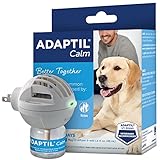
Adaptil Calm Home Diffuser Kit for Dogs
Adaptil
3. Food-Stuffed Toys: Create a Positive Alone-Time Association
The goal of this strategy is to make your departure the signal for something your dog actively looks forward to. A Kong stuffed with high-value food — peanut butter and kibble, or wet food frozen overnight — becomes your dog's cue that alone time means something good happens.
This works for mild to moderate anxiety. The key is exclusivity: the stuffed Kong is only available when you leave. Your dog never gets it while you're home. Over weeks, the departure ritual becomes associated with the Kong rather than with your absence.
The KONG Classic is the right starting product. Sized correctly (large or XL for medium/large breeds — don't buy a size that your dog can empty in 90 seconds), stuffed densely, and frozen, it can occupy an anxious dog for 30–45 minutes — which covers the peak distress window in most mild cases.

KONG Classic Dog Toy
KONG
4. A Pressure Wrap: Physical Comfort During Acute Anxiety
Pressure wraps like the ThunderShirt work on the same principle as swaddling an infant — gentle, constant pressure activates the parasympathetic nervous system and reduces the physical symptoms of anxiety. Research shows roughly 80% of dogs show some improvement with a properly fitted pressure wrap.
The ThunderShirt is the most studied brand in this category. Fit matters enormously — too loose and it has no effect; too tight and it creates a different kind of distress. The sizing guide is based on weight and chest girth; follow it precisely. Put it on your dog 5–10 minutes before a departure, not immediately at the door.
I used the ThunderShirt on my Lab during the middle phase of treatment, when the Kong and diffuser were helping but the first 15 minutes after departure were still stressful. It reduced visible panting and pacing in that window noticeably.
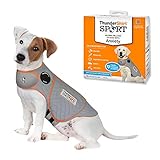
ThunderShirt Sport Dog Anxiety Jacket
ThunderShirt
5. A Heartbeat Toy: Comfort for Dogs Sensitive to Isolation
The Snuggle Puppy is a plush toy with a battery-powered "heartbeat" — a pulsing vibration that mimics a resting heartbeat. It was originally designed for puppies during the first nights away from their litter, but it's genuinely effective for adult dogs with separation anxiety who are particularly responsive to physical comfort.
It won't work for every dog. My Labrador showed zero interest in it — he's not a toy-sleeper. But the Staffordshire Bull Terrier I mentioned in other reviews, who sleeps pressed against me at night, settled noticeably faster when I tested the Snuggle Puppy during a two-week trial while his owner was travelling.
If your dog is one that seeks contact and body warmth when anxious — presses against you, tries to get on the furniture, sleeps touching something — the heartbeat toy is worth trying before investing in more complex interventions.

Snuggle Puppy Behavioral Aid Dog Toy
SmartPetLove
The Step-by-Step Routine That Actually Builds Tolerance
Products help manage symptoms. This routine builds genuine tolerance over time. It takes 8–12 weeks for most dogs with moderate anxiety — there is no shortcut.
Week 1–2: Desensitise departure cues
Your dog's anxiety begins when they see the departure cues, not when you leave. Spend 10 minutes a day picking up your keys, putting on shoes, and picking up your bag — then sitting back down without leaving. Repeat until your dog stops reacting to these cues. This alone reduces the total anxiety duration because you've eliminated the pre-departure stress spike.
Week 3–4: Practise micro-absences
Leave for 30 seconds. Return calmly. No drama on either end. Gradually extend: 1 minute, 3 minutes, 5 minutes, 10 minutes. Never return while your dog is barking or whining — wait for a 3-second pause, then return. Returning to a vocalising dog rewards the vocalisation.
Week 5–8: Extend to 30–60 minutes
Increase absence duration in 5–10 minute increments every 2–3 days. Deploy the Kong on every departure. If you hit a regression (behaviour gets worse), step back two increments and rebuild more slowly — rushing this phase is the most common reason the programme fails.
Week 9–12: Real-world durations
By now most dogs with mild-to-moderate anxiety can handle 2–4 hours. The final step is extending to full working-day absences. Add the diffuser and ThunderShirt for the first month at full duration. Use the camera to verify actual behaviour, not assumptions.
Ongoing maintenance:
- Keep the Kong ritual going indefinitely — it maintains the positive association
- Keep departures brief and calm permanently
- If you have a significant schedule change (new job, return from holiday, new baby), expect a 2–4 week adjustment and proactively increase mental enrichment during that period
When to See a Vet
This guide covers behavioural management for mild to moderate separation anxiety. If your dog:
- Is injuring themselves trying to escape (broken teeth, self-inflicted wounds)
- Cannot settle at all after 2–3 hours alone even after 6+ weeks of the above programme
- Has extreme fear responses (loss of bowel control, inability to eat for the entire day)
...book an appointment with a veterinary behaviourist, not just a standard vet. In Canada, your vet can refer you to a board-certified veterinary behaviourist (Diplomate ACVB) or a certified applied animal behaviourist (CAAB). Anti-anxiety medication (typically fluoxetine or clomipramine) combined with behaviour modification produces significantly faster results in severe cases than behaviour modification alone. There is no failure in using medication — it lowers the anxiety floor so the training can actually work.
Frequently Asked Questions
How long does separation anxiety take to fix?
Mild cases: 4–8 weeks with consistent training. Moderate cases: 8–16 weeks. Severe cases with medication: 3–6 months. There is no permanent fix without behaviour modification — management tools alone slow the regression without resolving the underlying anxiety.
Can an older dog develop separation anxiety out of nowhere?
Yes — and this is common. Changes in household routine (owner works from home for a year then returns to the office), loss of a companion dog or human family member, a health change that increases dependence, or cognitive changes in senior dogs can all trigger separation anxiety in dogs with no prior history. The treatment approach is the same regardless of onset age.
Is separation anxiety the same as boredom?
No, though they can look similar. A bored dog is relaxed — they chew things because there's nothing else to do. An anxious dog is in distress — they chew things as a physical outlet for panic. The key difference: a bored dog will eat treats and engage with toys left behind. An anxious dog often won't. Check with a camera if you're unsure.
My dog is fine when my partner stays home. Does that mean it's not separation anxiety?
It means the anxiety is specifically attached to your absence (or the absence of a specific person), which is a common pattern. The treatment is the same: gradual desensitisation to your departures specifically, combined with management tools during the programme.
Related Articles
- Best Dog Beds 2026 — an orthopaedic bed can help anxious dogs settle more quickly when alone
- Best Dog Toys for Aggressive Chewers Under $20 — high-drive anxious dogs often chew destructively; redirect the behaviour with appropriate toys
- Best Dog Food 2026 — a dog that won't eat when alone is one of the key diagnostic signs; good food palatability helps distinguish anxiety from preference
- Best Dog Water Fountain 2026 — anxious dogs often drink less when stressed; a fountain encourages intake during alone time